

Google rolls out a “rich results” report for products in Search Console
 Anders Bohman
A lot is happening on the Google Search Console front. We have previously written on the blog about Google’s speed report. Google recently announced that it is now rolling out yet another report in Search Console—this time a report for product “rich results.” This article will explain what this means for site owners and how the new “rich results” report can be used to analyze data. To make the terminology easier to understand, we begin by explaining what “rich results” actually are.
What are “rich results”?
“Rich results” are the additional information a user receives directly on Google’s search results page. They go beyond the clickable link and meta description. Rich results can include images, review ratings, stock availability, and other useful information that users can access at a glance.
Since Google’s new report focuses on products, we want to show a few examples of product-related rich results to give a clear picture of what we mean by “rich results.”
The first example is one of the most common use cases for rich results on Google’s search results page.

Another example of product rich results comes from Google Image Search. One thing to note about image search is that stock availability is more often shown here than on the regular search results page.

To increase the chances of earning rich results, pages should be marked up with structured data, as this improves Google’s ability to understand and interpret the site’s content. However, implementing structured data does not guarantee that a page will receive rich results. You can read more about how to implement this in our blog post on structured data.
What do product “rich results” mean in Google Search Console?
If your products are marked up with structured data, the new report allows you to access performance statistics for these products and see how they perform.
Google themselves state:
“Website owners need to understand the impact of these rich results. The Google Search Console Performance report provides key metrics like clicks and impressions to help webmasters understand and optimize the performance of their website results on Google Search. These metrics can further be segmented by device, geography and queries.”
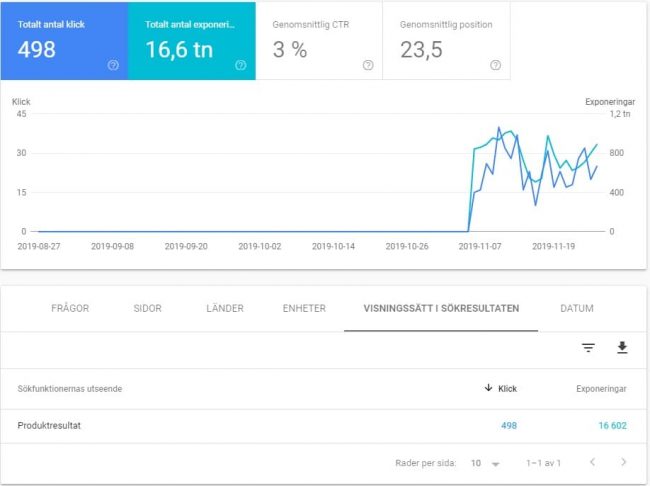
Using the report, you can see the number of clicks, impressions, click-through rate, and average position that your products with rich results have achieved. As Google mentions above, you can also segment the data by device, user location, and search query.
The rich results report looks like this:
How do you find the new report?
Finding the new report can be a bit tricky if you are not familiar with Google Search Console. To navigate to the report, you first need to log in to GSC, go to “Performance” in the menu, then select “Search appearance,” and finally click on “Product results.”
Please note that if you have just marked up your products with structured data, it may take several weeks before Google detects this. As mentioned earlier, implementing structured data does not guarantee that Google will reward your efforts with rich results. If you want to test whether your products are optimized for rich results, you can do so using Google’s rich results testing tool.
Final thoughts
It is always exciting when Google launches new ways to better understand user behavior. For those of us working with SEO, this report is particularly interesting, as it will now be easier to determine whether rich results contribute to a higher or lower click-through rate. Providing more information to potential visitors can both help and hurt performance.
We are confident that click-through rates increase for pages that can display positive product reviews and show that an item is in stock, while CTR is likely negatively affected if a product is currently out of stock.
We hope that Google continues to develop this report—and future reports—so that site owners can gain even more insight into how their website optimization efforts are performing.
