


For some time now, Google has begun a crusade against unencrypted connections on the web. They want websites to encrypt pages where data is sent, beyond simple retrieval for reading. You recognize this by their preference for https instead of http.
As early as January 12, 2015, we changed our recommendation to state that websites should be encrypted. The reason was that Google announced they would start warning users in Chrome when websites are not encrypted. The warning that has appeared so far is not very prominent and likely does not make a major difference for, for example, conversions. The image below shows what is displayed when you hover over the information “i” in the address bar.

This is shown in contrast to a secure connection, which is instead marked with a padlock rather than an “i”.

In the image above you can also see what it looks like with an extended certificate. We chose the slightly larger certificate option when we switched to https, which is why you see the company name and country displayed in green.
Google is now expanding the warning
Google is now taking the next step in its warnings, at least if we interpret the message that landed in our inbox this morning correctly. The sister site to this one, brath.com, currently does not provide an encrypted connection. The reason is simply that it has not been prioritized, as it is intended to reach international customers in the future—something we have not focused on yet (the domain was mainly purchased to secure it). This has resulted in the following message from Google:
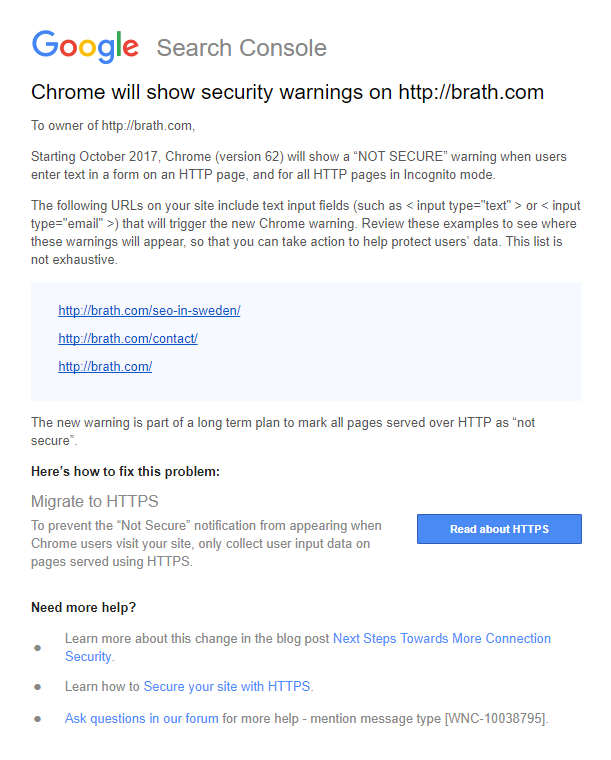
Note that Google has here identified pages where information can be sent to the site owner—in this case, where contact forms are present. We can likely conclude that the warning will become more prominent than just a small information box in the address bar once Google rolls out this change.
At present, we are not sure whether this change will apply only to a selection of sites in October (2017) or if it will be rolled out more broadly. If you have received a similar message, please feel free to let us know.


