



It is now impossible for a listing to both obtain a featured snippet on Google and simultaneously rank on the first page of the same search results. In today’s article, we explain why and also share our analysis of this change.
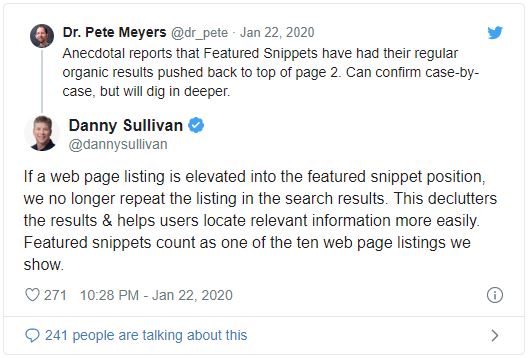
On January 22, 2020, rumors quickly began circulating within the SEO community claiming that listings which had secured a featured snippet had lost their organic first-page ranking and were instead placed at the top of page two.
This was shortly thereafter confirmed by Google’s Danny Sullivan on Twitter. According to Google, the reason behind the decision is that it cleans up the search results, making it easier for users to find relevant information.
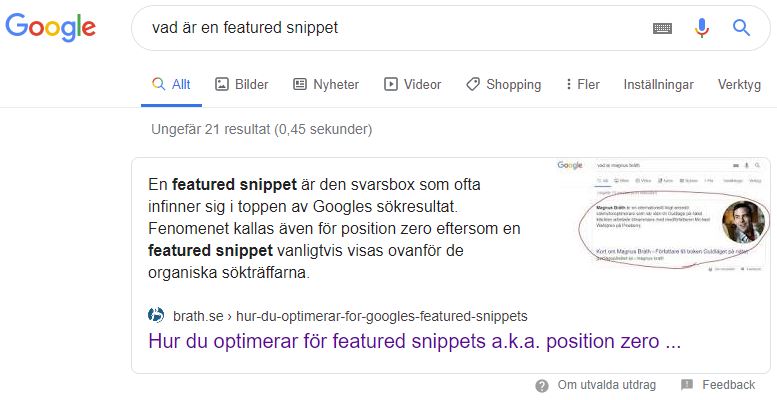
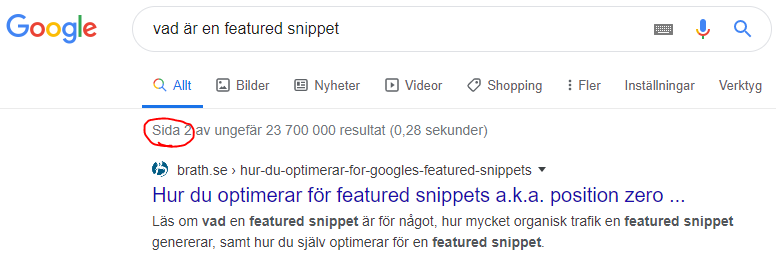
We have verified this ourselves, and indeed our regular organic listing is now placed at the top of page two of the search results for the query “what is a featured snippet,” where we currently hold a featured snippet and previously ranked at the top of page one.
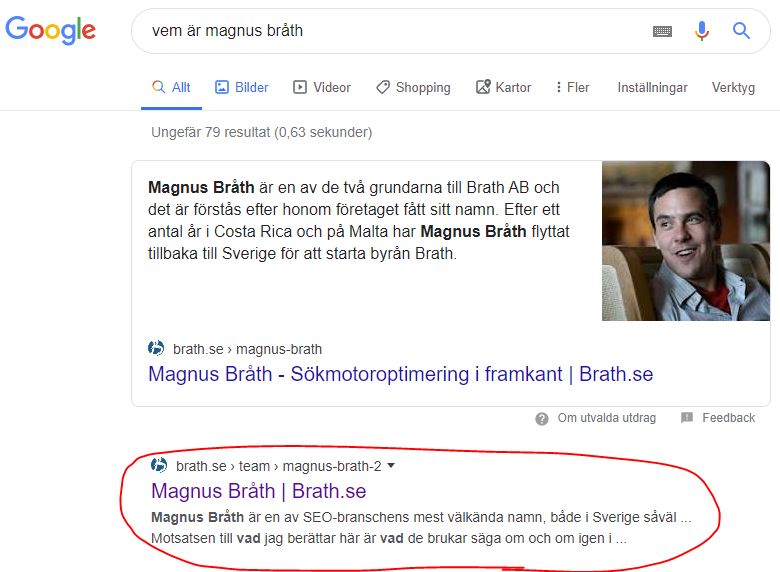
NOTE! It is worth mentioning, however, that it is still possible to rank on the first page of a search result where you have a featured snippet. This must be done with a different listing, meaning a different page on your site.
What are the effects of this change?
Negative effects and possible solutions
First of all, we would argue that this is a change that will hardly go unnoticed. In cases where websites previously held both a featured snippet and a top ranking for a high-volume search query, there will likely be a noticeable drop in organic traffic.
According to a study by Ahrefs, around 8% of Google users click on a featured snippet. This can be compared to a study by Backlinko, which shows that approximately 30% generally click on the listing that ranks first.
For queries where you previously managed to secure both a featured snippet and the number one position, it can be simplified to saying that you may now lose around 30% of your previous traffic. A rather worrying insight.
Because of this, one could argue that websites with strong potential to rank at the very top of the organic search results should stop optimizing for featured snippets altogether.
That said, your site may no longer deserve rank one if you choose to approach the situation in that way.
Another potential solution could be to try replacing a featured snippet with an expected first-place ranking by instead using the “nosnippet” meta tag. This tag tells Google, among other things, that it is not allowed to use body text from a page in a featured snippet.
Whether we recommend this or not is currently unclear, but it is certainly possible to experiment on your own to determine whether it works and what ultimately generates the greatest amount of organic traffic.
Positive effects
From another perspective, the new guidelines for featured snippets are positive for those who are not particularly close in the competition for a featured snippet and who also rank below those who are.
One of your strongest competitors simply loses one of their listings in the search results, which automatically means that you move up a position. Not too bad.
This also creates a more even distribution of organic traffic, which should be beneficial for many smaller players.
On the other hand, if you have managed the feat of securing a featured snippet, you do not need to worry about losing all of your visibility if it unfortunately disappears.
In that case, the chances seem high that it will instead be replaced by your previous top ranking, while competition at the very top decreases, as it is likely that one of your main competitors is filtered out.
Have you noticed any difference?
As always, we at Brath are curious. Feel free to leave a comment on this page if you have noticed a clear decline in your organic traffic since January 22. This applies specifically to searches where you previously had both a top ranking and a featured snippet, and not for other reasons.
