


SEO and PPC can seem very similar, and in many ways they are, but that isn’t always true since they can serve different purposes. There are some inherent characteristics in both disciplines that give them completely different roles in certain situations. In the conversion funnel, for example, they can fulfill very different functions.
Last Friday I came from an interesting meeting where we discussed, among other things, the role of search engine optimization and keyword advertising in the conversion funnel. Right after the meeting, it struck me how well this describes the differences between advertising and optimization. I’ve put together a funnel below—there’s no specific logic behind the individual steps; it’s meant to reflect how most people view their own conversion process. At the top is some kind of discovery phase, in the middle an interest has been sparked, and in the final step the visitor is ready to buy. If you’re not familiar with this type of funnel, it’s essentially a purchase journey. A potential customer enters somewhere (often at the top) and is then, in some smart way, guided down through the funnel to eventually complete a purchase. What I want you to take a closer look at is SEO and PPC in the image.
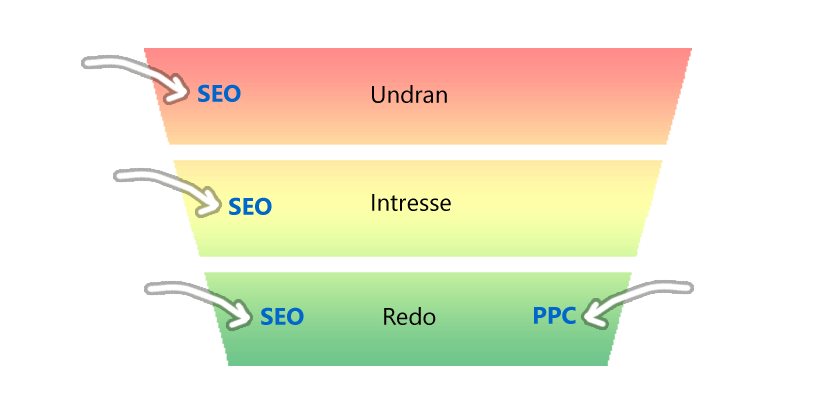
Often, both within search engine optimization and paid search advertising, the focus is on the very last step. That’s not particularly strange—it’s very easy to measure results there, and it’s often where you find the lowest-hanging fruit. For some reason, many web initiatives miss exactly this step. Companies run banners, build brand awareness, and invest in content marketing, but when the visitor is finally ready to buy, they’ve completely failed to capture them—and the visitor ends up on PriceRunner, eBay, or something similar. The main point of both SEO and PPC is that you can seal that final step. When the customer has decided to buy a cast-iron toaster, you’re there and ready to sell one.
It doesn’t always have to be the only focus
That doesn’t mean it always has to be where you focus your efforts—especially not if you’ve already taken a strong hold of that step. Within PPC in particular, this is relatively easy to measure and manage. After some time, you should know which keywords in your segment have purchase intent and which do not. The keywords that convert best will be found at the bottom of the funnel. Compare Buy new Audi with Audi emissions cheating. One is at the very bottom of the funnel; the other is at the top—if it’s even relevant at all.
If you feel confident that you’ve secured that step, there are good reasons to start driving traffic at other levels of the funnel. This is where we arrive at the big difference between optimization and advertising. Even though AdWords tends to be relatively inexpensive for keywords higher up in the funnel, it’s still a cost per click. Since the idea is to reach very broadly, the result is a large number of clicks with very low value. A huge proportion of searchers aren’t anywhere near making a purchase. People interested in the Volkswagen Group emissions scandal aren’t exactly ready to buy a new Q7—and with high probability, they never will be.
It can be worth buying clicks to content that fits these stages, but you need deep pockets and a long-term horizon if you want to calculate a positive ROI. Search engine optimization, on the other hand, has the opposite effect. With a site that has strong authority (which you should have if you feel confident about controlling the final step—competition is often much higher there), you can go a long way with well-balanced content and solid technical foundations. Content that fits higher up in the funnel also tends to be easier to attract links to.
SEO becomes the opposite of PPC
I would even argue that it becomes easier to rank far down the funnel if you’re supported by really good, well-optimized content higher up. Instead of dealing with a runaway PPC budget, you actually get help from the content (and its ability to more easily attract links), making search engine optimization itself easier. Take this site as an example. There are a handful of highly converting keywords in our segment. Even though I wouldn’t dare claim we have them all locked down, we spend a lot of time capturing those who are searching because they’re interested and want to learn more about search engine optimization. Today’s Search Query is perhaps the best example—we don’t expect someone who just watched a clip about title tags to request a quote. That’s why it’s difficult to calculate a positive ROI for PPC in this case, but for SEO, it’s more of a benefit than a cost to continuously add this type of content.


